Indoor Air Quality Assessment: What HVAC Technicians Measure
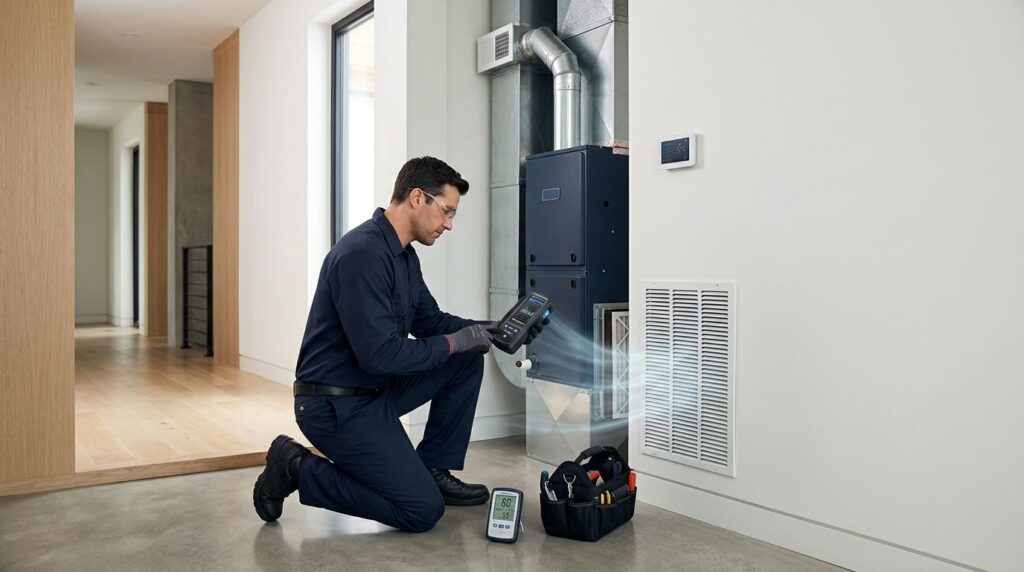
Recurring headaches, stale bedrooms, damp odors, and fast-returning dust shouldn’t become part of normal home life. A thorough indoor air quality evaluation connects those clues to measurable HVAC performance, moisture, and pollutant conditions. It helps trace likely causes and identify air contaminants, without promising a medical diagnosis.
West Alabama heat and humidity put extra pressure on ducts, drain lines, filters, and cooling equipment, affecting your indoor environment. We start by looking at how your home moves, filters, and manages air before deciding which pollutant tests will give useful answers.
Key Takeaways
- An indoor air quality assessment connects recurring odors, dust, moisture, comfort concerns, and symptoms to measurable HVAC and building conditions without diagnosing a medical issue.
- HVAC technicians should evaluate airflow, filtration, pressure, ventilation, humidity, drainage, and accessible ductwork before recommending specialized pollutant testing.
- Air quality monitors can reveal trends in particles, carbon dioxide, humidity, temperature, and sometimes TVOCs, but they cannot identify every contaminant or replace an HVAC inspection.
- Laboratory testing is most useful for focused questions involving concerns such as mold, formaldehyde, volatile organic compounds, or radon.
- Correcting moisture sources, restoring airflow, improving filtration, and addressing combustion risks should come before relying on air purifiers or dehumidifiers.
When an Indoor Air Quality Assessment Is Worth Scheduling
An assessment makes sense when a comfort or health concern keeps returning despite normal cleaning and filter changes. It also helps after a leak, renovation, HVAC breakdown, or a long period of high indoor humidity.
Symptoms and building clues to track
Poor indoor air quality may contribute to irritated eyes, coughing, headaches, fatigue, respiratory issues, worsened allergies, and asthma symptoms. These symptoms can have many causes, so they’re possible clues, not proof of an indoor cause.
However, recurring patterns can justify an environmental health investigation without diagnosing occupants. If symptoms improve away from the building, several building occupants notice them, or a room has a persistent musty smell, the building deserves a closer look.
Other useful clues include signs of mold and moisture, condensation on windows, water near an air handler, uneven room temperatures, visible staining, or dust collecting near supply vents. We ask when the issue occurs, what changed before it began, and how humidity levels vary with weather and HVAC operation.
A timeline gives test results meaning
Write down recent painting, new flooring, pest treatments, water damage, renovations, and changes to household products. Also note whether problems worsen during rain, when the AC runs, or after cooking.
For landlords and property managers, document tenant reports alongside repair dates and water events so building management can track the pattern. Air samples are only snapshots, while a clear timeline can reveal a pattern that testing confirms.
What HVAC Technicians Measure First
Rather than beginning with a laboratory sample, we first evaluate conditions shaping indoor air quality.
That includes airflow, filtration, moisture control, and ventilation systems.
An air quality monitor can show trends, but it doesn’t replace HVAC measurements of indoor air movement or fresh outdoor air delivery before ordering specialized tests.
Airflow, pressure, and filtration
Restricted airflow often links comfort complaints to air quality concerns. We inspect air filters for type, fit, and system compatibility, along with return grilles, accessible ducts, blower performance, coil condition, and supply airflow at individual registers.
A digital manometer can measure static pressure across the system. High pressure may point to a restrictive filter, blocked return, dirty coil, undersized duct, or too many closed registers.
A duct blaster can also test leakage. It reports air loss in CFM25, meaning the airflow needed to hold the duct system at 25 Pascals during testing.
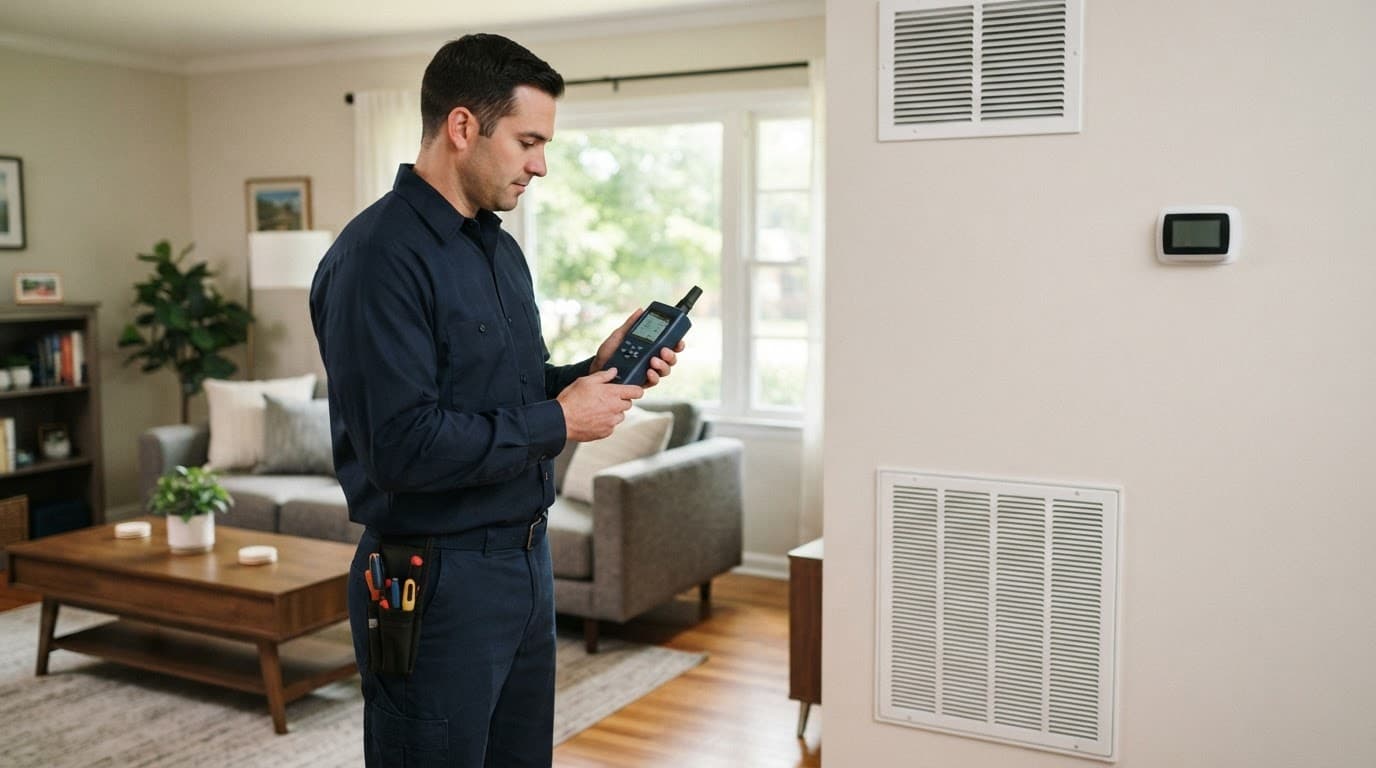
A duct leakage result in CFM25 measures air escaping under controlled pressure. It does not show how much air reaches one bedroom register.
Temperature, humidity, and moisture conditions
Relative humidity affects comfort, mold risk, dust mites, and how well the cooling system removes moisture. We compare humidity levels in several rooms with the thermostat setting, equipment runtime, drain condition, and accessible insulation.
The EPA recommends keeping humidity levels below 60%, with 30% to 50% as a practical target range for many homes. High humidity can come from an oversized system, low airflow, duct leakage, crawl-space moisture, or a blocked condensate drain.
How Air Quality Testing Moves Beyond a Basic Screen
A sound monitoring strategy uses the method that fits the concern. Continuous monitors can reveal indoor air quality trends, while lab work can identify a specific contaminant after a focused inspection.
Monitors reveal daily patterns
An air quality monitor can track particulate matter, carbon dioxide, temperature, humidity, and sometimes volatile organic compounds (TVOCs). The Airthings View Plus is one consumer monitor that also tracks radon levels relevant to radon exposure.
Place the air quality monitor away from supply vents, direct sunlight, kitchens, and humidifiers so it reflects the broader indoor environment. Watch the air quality monitor for several days to capture normal trends. The air quality monitor shows PM2.5 particulate matter, not its source; cooking-related spikes differ from wildfire smoke or heavy pollen.

Photo by Tim Witzdam
Laboratory samples answer narrow questions
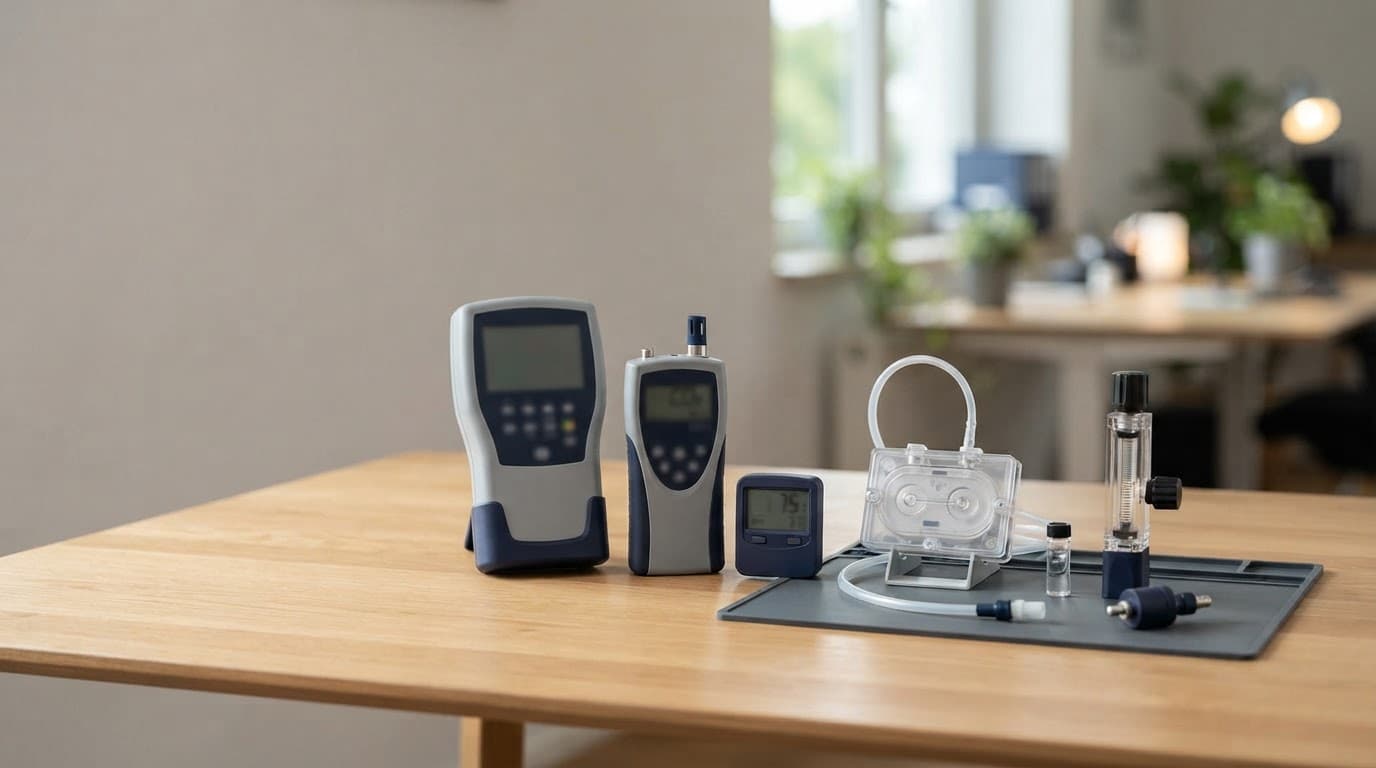
Targeted laboratory work can investigate indoor air quality when a monitor points to a pattern that needs closer study. Professional testing can use air samples to check for formaldehyde, individual volatile organic compounds, mold-related concerns, and other air pollutants. Sampling should follow a plan that considers room use, outdoor conditions, HVAC operation, and likely contaminant sources.
Radon also needs a dedicated test to evaluate radon exposure. It is a naturally occurring radioactive gas that can enter through soil and foundation openings. The EPA recommends fixing homes at radon levels of 4 picocuries per liter (pCi/L) or higher.
Common Causes of Poor Indoor Air
Air contaminants rarely come from one dramatic source. More often, several modest contaminant sources combine over time, including HVAC issues, moisture problems, outdoor pollutants, and household activities. Together, they can gradually affect indoor air quality.
Moisture damage and mold growth
A wet crawl space, plumbing leak, failed roof flashing, blocked condensate line, or poorly insulated duct can raise indoor moisture. Mold and moisture problems can follow when materials stay wet, allowing growth on drywall, insulation, carpet backing, and framing.
An air sample cannot reliably rule out mold hidden behind a wall. We look for the moisture source first, because cleaning odors or running a purifier won’t correct ongoing water damage.
Particles and chemical pollutants
Particulate matter includes airborne particles, and PM2.5 is small enough to enter deep into the lungs. Cooking smoke, candles, tobacco smoke, outdoor air pollutants, construction dust, and poorly filtered return air can all raise particle levels. Elevated particles can aggravate respiratory issues, especially for sensitive people.
Volatile organic compounds can come from paint, flooring, cleaning products, air fresheners, furniture, and stored fuels. Those materials can release chemical vapors. A TVOC reading can show that chemical emissions changed, but it does not identify the exact chemical or its health risk.
Combustion and garage-related risks
Fuel-burning furnaces, gas appliances, fireplaces, and attached garages require special care. Technicians inspect combustion equipment, venting, air intake, and carbon monoxide conditions during a wider safety review for related health hazards.
Carbon monoxide has no color or odor. If a CO alarm sounds, leave the home and call 911, the fire department, or your gas utility from outside. Do not wait for an air test or try to silence the alarm.
Indoor Air Quality Numbers Need Context
Measurements help, but one number never tells the whole story. When interpreting indoor air quality readings, we consider the indoor environment, home operation, occupant concerns, and the applicable testing standard. An air quality monitor can add context by showing whether readings persist or change.
| Reading | What it may indicate | Useful comparison point |
|---|---|---|
| Relative humidity | Moisture control, comfort, mold risk | Aim for 30% to 50%; keep below 60% |
| PM2.5 | Cooking, smoke, outdoor air, filtration | Some LEED certification IAQ protocols use 12 µg/m3 |
| Formaldehyde | New materials, furniture, finishes | 27 ppb appears in LEED certification assessment criteria |
| Carbon monoxide | Combustion or vehicle exhaust concern | 9 ppm over eight hours is a common EPA benchmark |
| Carbon dioxide | Occupancy and ventilation conditions | Compare trends with outdoor levels and room use |
Carbon dioxide is useful as a ventilation clue, but it isn’t a universal safety score for every room. A crowded conference room, closed bedroom door, fresh outdoor air, and limited air exchange can all affect it. An air quality monitor becomes more useful when you compare its trends with room use and system operation.
Ozone needs similar care. The EPA’s eight-hour outdoor ozone standard is 0.070 ppm, while project-specific indoor criteria can differ. We don’t recommend ozone-generating machines in occupied homes to remove odors.
When Home Monitoring Isn’t Enough
An air quality monitor gives you a helpful baseline for indoor air quality, especially when tracking moisture or ventilation patterns. It cannot inspect a dirty coil or diagnose a duct restriction.
An air quality monitor also can’t determine whether air filters are restrictive or poorly fitted. It can’t tell when they’re overdue for replacement or find moisture inside a wall.
Use an air quality monitor to guide practical changes
Run the monitor before and after changing a filter, using kitchen exhaust, repairing a drain issue, or adjusting ventilation. That approach shows whether the change improved the trend.
For example, a sharp particle increase during cooking points toward source control and better exhaust ventilation. A constant moisture problem during cooling points toward equipment performance, ductwork, drainage, or building moisture.
Bring in the right professional
Professional testing is the better choice when you have potential health hazards, including:
- Persistent musty odors, recurring water damage, or visible mold growth.
- A carbon monoxide concern, soot, flame irregularities, or a combustion smell.
- Recurring respiratory issues in the same room or building.
- Workplace complaints, a commercial building investigation, or documentation needs for LEED certification.
OSHA does not have one universal indoor air quality standard for every workplace. However, employers still have applicable duties under the General Duty Clause and substance-specific rules related to occupational safety. Complex workplace investigations may require industrial hygiene expertise and air quality testing. Local HVAC technicians can diagnose mechanical causes in ventilation systems, while an industrial hygiene professional can coordinate the investigation and prepare its report.
At Northport HVAC, we evaluate HVAC airflow, drains, accessible ducts, filters, and equipment operation before recommending repairs. If the issue points to the system itself, our HVAC services in Northport, AL can address the underlying heating and cooling problem.
Fix the Source Before Adding More Equipment
Air purifiers and dehumidifiers can help improve indoor air quality in the right setting. Still, they work best after you correct the contaminant sources that keep introducing pollutants or moisture.
Restore airflow and filtration
Choose air filters in the size and type your equipment can handle, and replace them before they become packed with dust. Our guide on how often to change HVAC filters in Alabama can help you set a schedule based on pets, occupants, and filter type.
Keep return grilles clear, avoid closing multiple supply vents, and repair loose or crushed ducts. Standard gray duct tape often fails in attic heat and humidity, so proper duct repairs use mechanical fastening, mastic, or approved UL 181 foil tape.
Stop water and control humidity
Repair plumbing leaks and clear condensate drainage problems first. Address crawl-space moisture and control humidity levels before cleaning or replacing materials damaged by mold and moisture. Duct cleaning may remove heavy renovation dust, but it cannot repair a separated collar, failed duct seam, or wet insulation.
Weak cooling, frozen coils, and water around an air handler can also worsen humidity. Those problems often appear during a Northport AC repair call or a Tuscaloosa air conditioning service visit. If your system fails during dangerous heat, emergency AC repair may be the safer choice. An air quality monitor can help verify whether repairs improved indoor air over time.
Frequently Asked Questions
What does an indoor air quality assessment measure?
An assessment may measure airflow, system pressure, filtration, temperature, humidity, ventilation, and moisture conditions. Depending on the concern, it may also include monitoring or targeted laboratory testing for specific pollutants.
Is a home air quality monitor enough to identify the problem?
No. A monitor can show trends in particles, carbon dioxide, humidity, and other readings, but it cannot inspect a dirty coil, find hidden moisture, or diagnose a duct restriction. Use its data to guide practical changes and determine whether professional evaluation is needed.
When should indoor air quality testing include laboratory samples?
Laboratory samples are most useful when a focused inspection identifies a specific question about mold-related concerns, formaldehyde, volatile organic compounds, or another pollutant. Sampling should account for room use, outdoor conditions, HVAC operation, and likely contaminant sources.
What should I do if a carbon monoxide alarm sounds?
Leave the home immediately and call 911, the fire department, or your gas utility from outside. Do not wait for an air test or attempt to silence the alarm, because carbon monoxide has no color or odor.
Should I buy an air purifier before fixing my HVAC system?
Air purifiers and dehumidifiers can help in the right setting, but they work best after correcting the source of pollutants or moisture. Restore airflow, repair leaks and drainage problems, and address filtration or equipment issues first.
A Clearer Path to Healthier Indoor Air
A healthier indoor environment depends on controlled moisture, adequate airflow, source control, and measurements that fit the problem. An indoor air quality assessment has real value when it leads to a specific repair or habit change.
Track the symptoms and conditions you notice, then use monitoring or professional testing to confirm the likely cause. A measured diagnosis can turn a stale room, damp smell, or dust problem into a fixable home maintenance issue. It can also help identify recurring triggers associated with respiratory issues, without diagnosing a medical condition or adding equipment automatically.